Differentiator
Federation-first approach
Register nodes, expose a unified API, and run queries across sources in parallel—without relying on copy-first pipelines.
Federated Data Layer (FDL)
Query and govern distributed systems through a single interface, without centralizing all raw data. FDL provides federation-first access, metadata and semantic workflows, and policy checks at the gateway for cross-domain use.
Differentiator
Federation-first approach
Register nodes, expose a unified API, and run queries across sources in parallel—without relying on copy-first pipelines.
Standards
SensorThings, OData query semantics, and FAIR metadata
Use standard query patterns and metadata practices so integrations stay portable.
Design principle
Keep ownership with the source teams
Share access and governance without taking over how each source is operated.
Access is spread across many source systems
Governance differs from team to team
New integrations take too long to build and maintain
Trust is low without lineage and quality signals
One access layer, sources stay owned by their teams
Copy-first approach
A snapshot of what’s implemented in the UI today, and what’s still in progress.
Node cards, health states, protocol fields, and inspection views.
REST endpoints, query options, and examples rendered in the docs UI.
Multi-step flow, readiness checks, and scoring are in place.
Shown in the architecture flow; the planner service is not in this repo.
Described in the product flow; no runtime evaluator is included here.
Adapter contracts exist; several concrete connectors are still stubbed.
Demonstrational screenshots of a UI application implemented on the federated data interfaces for showcasing connected knowledge, and FAIR alignment workflows.
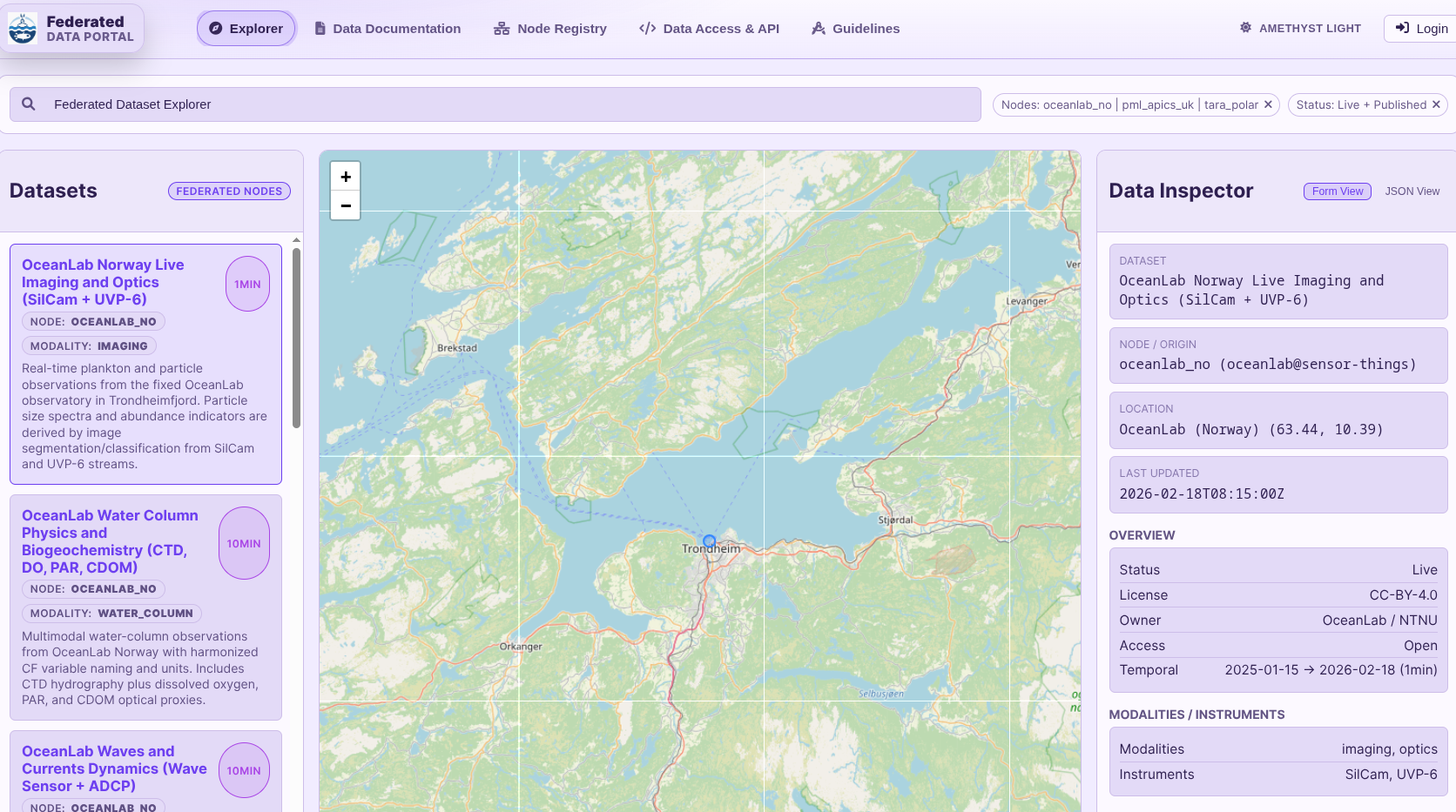
Browse distributed datasets through a federated catalog view.
Examples that follow the FDL contract model and standard OData-style query parameters.
Federated list query
curl -H "Authorization: Bearer <token>" \
  "https://<fdl-host>/api/v1/Entity?$filter=status eq 'active'&$select=id,name,updatedAt&$top=100&$skip=0"
Publish observation
curl -X POST -H "Authorization: Bearer <token>" -H "Content-Type: application/json" \
  "https://<fdl-host>/api/v1/Observations" \
-d '{"phenomenonTime":"2026-02-18T10:00:00Z","result":12.5,"Datastream":{"@iot.id":1}}'Capture metadata with FAIR guidance and readiness scoring.
Track node health with clear degraded states.
Workflow runs follow a simple lifecycle: queued, running, failed, completed.
Operational targets: 99.9% gateway uptime, P95 query latency under 2s, freshness lag under 5 minutes.
The UI already covers node management, documentation, and standards-based governance. The next step is the production runtime: planner, policy checks, durable metadata services, and connector execution.